Image: created with ChatGPT / OpenAI image generation
Overall structure
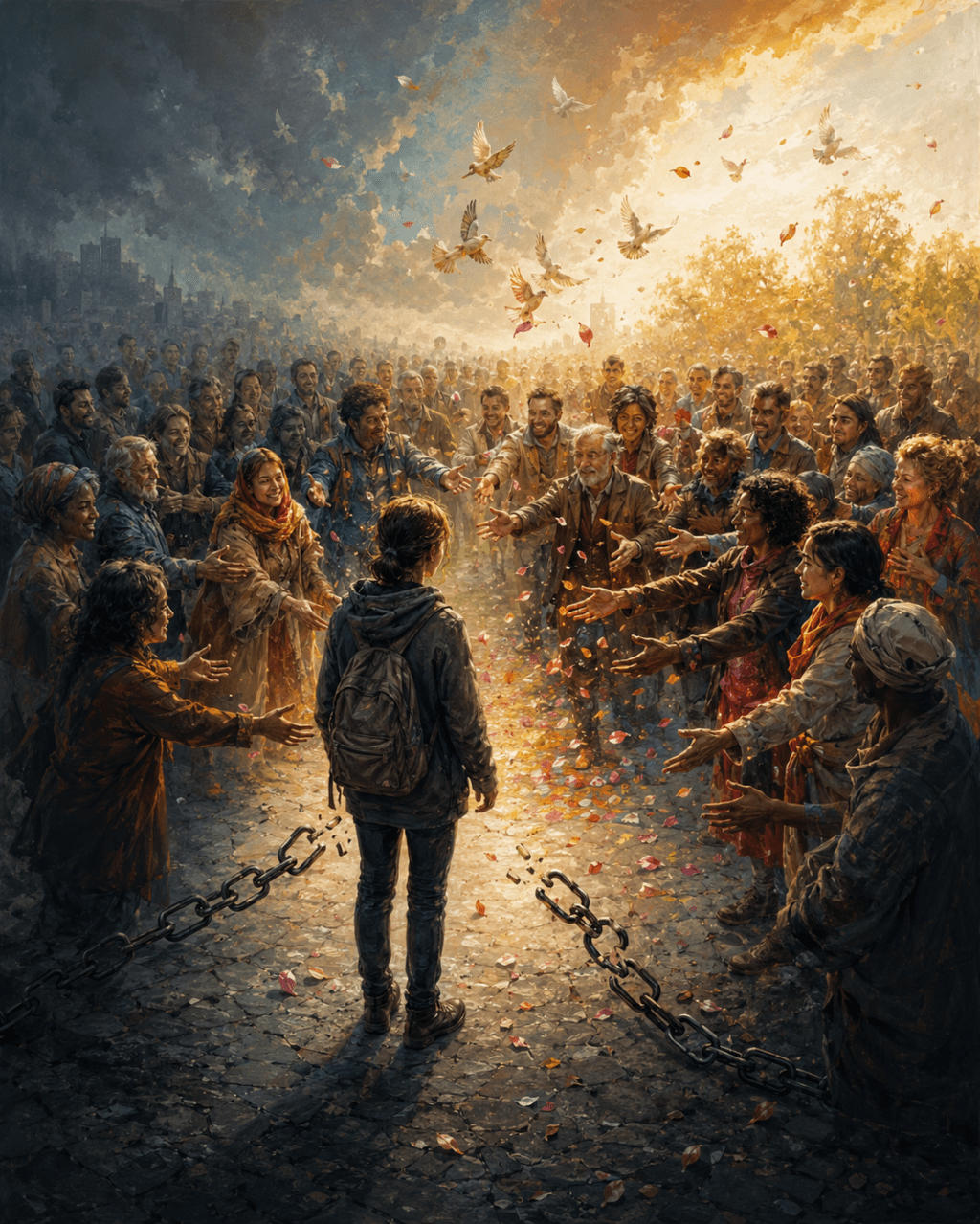
The image is built around a strong central threshold. A lone figure stands in the foreground with their back to us, facing a crowd that has opened into a welcoming circle. This creates a visual journey from isolation into belonging.
The composition divides the scene into two emotional zones: the colder, darker left side and the warmer, golden right side. The central figure stands between these worlds, making the image feel like a moment of transformation.
The crowd surrounds the figure, but not threateningly. Their arms are open, and the circle has become a passage rather than a barrier. The eye moves from the figure, through the open hands, into the sunlight, and finally upward toward the birds.
Symbolism
The central figure represents anyone who has been excluded, shamed, ignored, or pushed to the margins. Because their face is hidden, they become universal rather than individual.
The circle of people represents society or community. A circle can exclude when it is closed, but here it is opening, suggesting that community can choose welcome instead of rejection.
The outstretched hands symbolize acceptance, solidarity, forgiveness, and recognition. They are the opposite of pointing fingers or closed fists.
The broken chains on the ground represent the breaking of stigma, social punishment, prejudice, silence, or shame.
The birds rising into the sky suggest freedom, peace, release, and the lifting of the human spirit.
The petals or confetti soften the protest. They turn the scene from confrontation into celebration, implying that inclusion is not merely a duty but something beautiful.
The contrast between darkness and light symbolizes the movement from ostracism to acceptance, from fear to compassion, and from social coldness to human warmth.
Techniques
The image uses a painterly, cinematic style rather than realism alone. This makes it feel symbolic, almost like a mural or allegorical scene.
The artist uses chiaroscuro, or strong contrast between light and dark, to create emotional drama. The shadowed left side feels heavy and oppressive, while the golden light suggests hope and moral awakening.
There is a clear use of leading lines. The arms, bodies, path of petals, and broken chains all guide the viewer’s eye toward the central figure and then toward the illuminated crowd.
The image also uses scale and repetition. The lone figure is small compared with the large crowd, which emphasizes vulnerability. But the repeated open hands transform the crowd into a force of care rather than threat.
The warm colour palette on the right creates a sense of healing, while the cooler tones on the left create emotional tension. This colour transition helps tell the story without needing words.
The details in faces, clothing, petals, birds, and broken chains create richness and emotional density. The scene feels both public and intimate.
Meaning
The image protests against social ostracism by showing its moral opposite: inclusion. It does not simply condemn exclusion; it imagines what repair might look like.
Its central message is that no one should be left outside the circle of human concern. Social rejection is shown as something that can be broken, like the chains on the ground.
The crowd is important because the solution is collective. One person alone cannot undo ostracism; a community must choose to open itself.
The image suggests that acceptance is not weakness. It is active, public, courageous, and beautiful. The people reaching out are not passive bystanders. They are participating in an act of social healing.
At its heart, the image says: break the chains of stigma, open the circle, and welcome people back into belonging.
This post was written and illustrated in collaboration with ChatGPT.
 Nick's Corner
Leave a comment