Image: created with ChatGPT / OpenAI image generation.
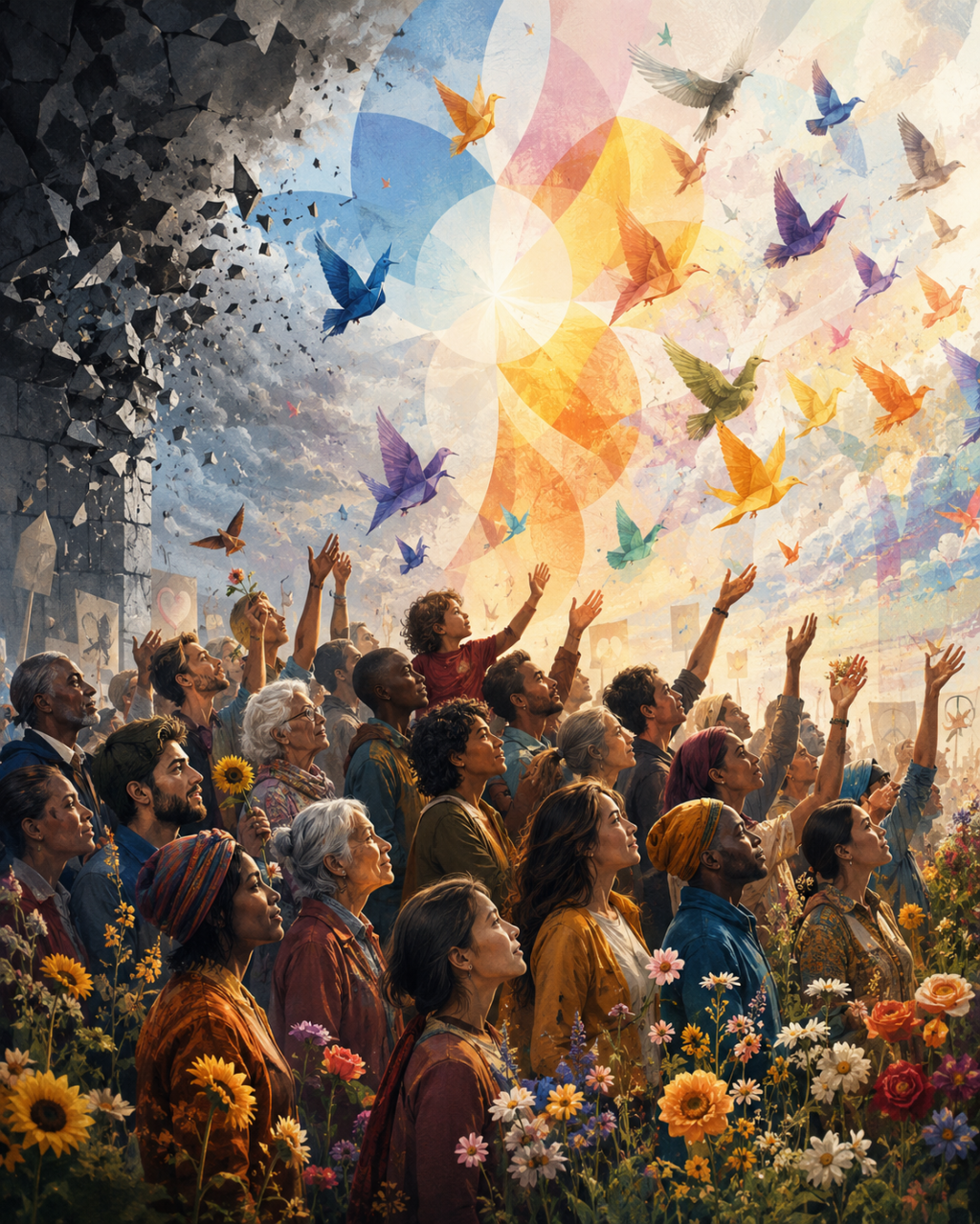
The image works as a visual argument for pluralism: it contrasts the brittleness of closed, intolerant thinking with the living, radiant, upward movement of diverse people sharing space together.
At a glance, it says: rigidity fractures; openness grows.
Overall structure
The composition moves from darkness on the left to light on the right and centre. That left-to-right movement gives the image a story without needing words. The cracked, blackened wall on the left represents extremism, intolerance, fear, and the urge to divide. It is not shown through any real-world symbol or party mark, which is important: the protest is against the pattern of extremism rather than against one specific group.
The centre opens into light, colour, birds, flowers, and human faces. That makes the image feel less like an angry denunciation and more like a moral alternative: “Here is what we choose instead.”
Symbolism
The diverse crowd is the core of the image. Different ages, ethnicities, clothing styles, and appearances are shown standing together, not as a blurred mass but as distinct people. That matters because the image is not saying everyone should become the same. It is saying difference can coexist with shared dignity.
The raised hands suggest several things at once: protest, release, blessing, appeal, and hope. They are not fists or weapons; they are open hands. That gives the protest a peaceful force. The people are active, but not hateful.
The birds and paper cranes symbolise freedom of thought, peace, migration, fragility, and the carrying of ideas. Because many of them are different colours, they also become symbols of varied viewpoints. They rise out of the crowd and into the light, implying that free expression and mutual tolerance allow society to become more expansive.
The flowers in the foreground represent growth, renewal, and life. They soften the protest imagery and turn the scene into something almost ceremonial. Flowers are also fragile, which makes the message more poignant: tolerance is beautiful, but it must be protected.
The overlapping translucent circles and coloured shapes in the sky are a strong visual metaphor for pluralism. Each shape keeps its own colour and boundary, but where they overlap, new colours and forms appear. That is probably the most direct symbol of diverse views: not a single imposed truth, but many perspectives creating a richer whole.
The dark shards and broken wall on the left show intolerance as something that ultimately destroys itself. The wall is rigid, heavy, and monochrome; the light is fluid, colourful, and full of motion. This contrast suggests that extremism may look strong, but it is spiritually and imaginatively impoverished.
Techniques
The image uses chiaroscuro, the dramatic contrast between dark and light, to make the moral contrast instantly readable. The left side feels compressed and heavy; the centre and right feel open and breathable.
It also uses directional movement. The birds, arms, faces, and light all pull the eye upward. That upward motion creates hope. Even before interpreting the symbols, you feel that the image is about emergence, release, and transcendence.
The crowd is arranged in a collective upward gaze, which creates unity without uniformity. Everyone is oriented toward the same luminous space, but their faces, clothes, ages, and positions remain different. That is a neat compositional equivalent of democratic coexistence.
The colour palette does a lot of emotional work. The left side is grey, black, and fractured; the right side is gold, blue, orange, pink, and green. It avoids making the image merely bleak. The protest is not “look how terrible the world is,” but “look what beauty we refuse to surrender.”
There is also a poster-like quality: bold contrast, clear symbolic staging, and a central moral idea. But it retains painterly detail, so it feels more like a humane mural than a slogan.
Meaning
The intended meaning is that intolerance narrows the world, while diversity of thought and identity enlarges it. Extremism is shown as a wall: hard, dark, separating, collapsing. Openness is shown as sky: luminous, layered, full of movement.
What I especially like is that the image does not frame tolerance as bland or passive. It shows tolerance as courageous, communal, and beautiful. The people are not merely “being nice.” They are standing together against something destructive, but they are doing so without becoming destructive themselves.
So the image’s deeper message might be:
A free society is not made by forcing everyone into agreement. It is made by protecting the space where different people, beliefs, voices, and hopes can rise together.
This post was written and illustrated in collaboration with ChatGPT.


Leave a Reply